Wednesday, March 22, 2023

Madhu’s Tantra Foundation: A Green Garden of Honey for the Scholar- Practitioner of an Enigmatic Vijnan - Neela Bhattacharya Saxena


It was a balmy day in Delhi at the end of the year 2022, and I was trying to find the farmhouse that the renowned Tantra scholar and a dear friend Madhu Khanna had invited me to visit.  The road from Gurgaon was nice and smooth, but the Google map was creating trouble.  These days drivers know little about the roads because they depend on those magic machines. Fortunately, a kind young man with a much smarter mind was able to fix the problem, and I was able to reach the beautiful Hari Bhari farm that was as green and wholesome as its name suggests.   

Tantra too in a way is a magic machine, but it is about our interior pathway rather than the one we usually walk or drive through.  It is easy to find the destination if the virtual map is consistent with the territory, but often we confuse the map for the real thing, especially when mere intellectual gymnastics are the preferred method. We have to be ready to take risks and be prepared to be lost on this royal road to our interiority where the colorful, dark, and deep Goddesses reside. Fortunately, finding the library was easier, and it contained the wealth that is waiting to be unearthed:   http://www.tantralibrary.com/


It has been almost two decades since I first met Madhu when I was at the tail end of completing my first book, In the Beginning IS Desire.  Perhaps the beginnings and ends are all about our desires, mostly unconscious. I recall how with such trepidation I joined the panel at the Delhi conference where Madhu was presiding. How was I going to talk about Chinnamasta, a fierce deity beyond understanding, in the presence of a formidable scholar of Tantra! But she had put me at ease, and since then I have been incredibly grateful to her for her guidance and friendship. 


It took me some time to realize that there are no "accidents" in life which is a seamless web of sparkling jewels where we meet people who can tap into our true humanity. Meeting Madhu has been one of those synchronicities emerging out of the womb of the Great Mother. I am the daughter of a Kali worshipper father and was given a terrifying glimpse of the road to that Void energy by my family’s Kali Sadhika Guru, Shiddha Ma. I feel it is her blessings that led me to Madhu and all the joys and trials along the way. I was pleased to see that Madhu’s efforts of a lifetime have yielded fruits as the Foundation library is teeming with rare books, old and new.

It is beautiful, and its every corner has the charm of a small retreat center that is inviting and alluring.  Her deft hands have created the space where wandering minds can find repose and get a firsthand exposure to the most enigmatic and exhilarating Indic spiritual and intellectual path. After all Tantra in its most intriguing and elusive aspects is the way of the “Woman” whose compassionate heart invites both male and female seekers. 


I thought of Madhu’s student Arghya Dipta Kar whom I met later in Kolkata. He received a Ph.D. on Tantra under her guidance and has been blossoming as a Shakta master par excellence. Arghya’s art and scholarship (https://www.facebook.com/diptaarghya/) reveal that the flow of this liberatory knowledge system is continuing uninterrupted.  I was still taking in the aroma of the library when fresh pakoras made with leaves from the farm with coffee arrived. We then sat down to talk about all the work that Khanna and her associates have been engaging in. 


Like any highly specialized knowledge system, an aspect of Tantra too is about our intellect. After all masters of this path spent millennia discovering the secrets of the body, mind, and spirit continuum of our existence. However, Tantra as a mechanism is also about discovering the sublime beauty and aesthetic dimension of our grounded existence on this earth.  Hence the building is full of gorgeous art and yantras that await the expert eyes to decode its enigmatic Vijnana.  The word Vijnana denotes both consciousness and what we know as science, a deliberate and concrete tool. 


What is most extraordinary about Tantra is that it puts the dreaded body, especially the female one, at the center of its illuminating methodology which, in a way, is a kind of psycho-archeology.  Digging deeper and deeper into the dark recesses of our embodied existence, Tantric masters have discovered the truth of here and now, the Kingdom of Heaven, or the Nitya Vrindavan of life.  Here, what I call the dancing dualities of our being in various forms sing and dance and speak in myriad voices. They reveal  the light and dark dimensions of a singular consciousness that plays hide and seek with us.


The yantras and mandalas of Tantric/Agamic paths whether they are Shakta/Shaiva, Jaina, Bouddha or Vaishnava, give us concrete instruments to discover that play. Madhu’s famous book Yantra: The Tantric Symbol of Cosmic Unity gave many of us a key to the mystic door of this enchanting path. Understanding the Vijnan of the mandalas and yantras, we can meditate upon the truth of “the Void of Nirvana and the luminosity of compassion” that my Vajraguru Kulavadhuta Satpurananda speaks of.  Incidentally, it is Madhu’s kind invitation to attend a Bengal Tantra conference that led me to him who initiated a new and difficult journey and anchored my longings for Kali into the clarity of her Shiva aspects. 


Madhu’s nourishing library is also like a labyrinth which can be a maze if we stumble upon it without Ariadne’s thread and can get devoured by the Minotaur of our minds. Books have their own magic secrets, the surface one of mere information and the shimmering hints of something more magnificent.  We have to take the chance of being lost in the maze that represents our own restless and unconscious mind that moves faster than the speed of light but cannot find repose without the grace of the Great Mother. Her insignia can be seen everywhere in the library; the books represent her Saraswati form that can take us from her exoteric white murti to the esoteric blue aspects, if and when our hearts desire the freedom that reveals life itself as a vibrant luminosity. 

Madhu shared many of her exciting projects and showed around her beautiful creation.  She also led me to the crucial references in esoteric texts that I needed for my current project. Since I was visiting India after almost 5 years with many stops to cover, I had to leave the retreat sooner than I liked. I walked out the door of the library into the greenery of the courtyard where a tree was bent with the weight of its fruits. Then in the most exquisite way of a Tantric Yogini, Madhu reached over and plucked a sapient lemon and gave it to me.  I took it as prasad and was happy that my journey which included visits to magnificent Buddhist sites from Kushinagar to Bodhgaya was blessed right in the beginning with Madhu’s fierce sweetness in her green farm.


Wednesday, August 26, 2020

Desert Luminosity and an Emerald Nile: Wings of Isis Open on the Road to Nag Hammadi - Neela Bhattacharya Saxena


Nile, Nile, O Emerald Nile! You have been flowing north from the heart of Africa for millions of years - sheltering birds, fish, and nurturing other entities in your silky bosom full of Yin energy with unfathomable strength. It was my first admission into the Mother continent where the beauty and grandeur of negritude glows. Egypt/Kemet, the terrain of black earth, is the place where geometry and alchemy were birthed. The Nile transports fertile, black mud from Ethiopia and Lake Victoria to regenerate the land and create the rhythm of life. The soft splashing of this blue green river is heard beyond the twittering of the white egrets that congregate on small islands and trees.

“I have known rivers…I looked upon the Nile and raised the pyramids above it.” Langston Hughes’ song in “Negro Speaks of Rivers” came truly alive as we traveled upstream on a slow moving dahabiya named Mary Rose. She picked us up in Esna, south of Luxor, and we savored the ancient rhythm of the river for five days before reaching Aswan. Nile feels utterly quiet as evening falls, small boats return home, and the call to prayer is heard from the shore. In Esna, Khnum, one of the oldest deities who presides over the Nile inundation, wears the double feather of Ma’at. The alchemical mysteries these extraordinarily talented people discovered were hidden inside the wings of Isis - an aspect of Ma’at. 

It felt like mere moments before Mother Earth taking the form of a virus sent everyone home to ruminate over our planetary predicament. However, the cosmos has not been sheltering in place. Recently a wonderful traveler from outer space visited us. The last time this celestial visitor rounded the sun and grew a tail was 6766 years ago. To be precise it was 4746 BCE.  Perhaps Neowise, the newly wise comet, is heralding the resurrection of Isis wisdom in us. Wisdom that might have existed from pre-dynastic times in the stone circles of Nabta Playa in the Nubian deserts.

Let us then time travel to Egypt to unite with their magic and The Egyptian Book of the Dead. It is funny that this Western mistranslation is also applied to The Tibetan Book of the Dead. Neither name is accurate. Muata Ashby, a contemporary master of Kemetic secrets, translates the Pert em Heru as The Book of Coming Forth by Day. Ashby shows us that the book is about creation and self-knowledge, and in this Anunian theurgy cosmic consciousness manifests in creation as Ra. In his writing, Ashby uses the original Kemetic names Aset, Asar and Heru instead of the Greek Isis, Osiris, and Horus. The hymns are startlingly like Vedic mantras except that the creator’s form in hieroglyph is Kheperu, the scarab beetle!

On our first day, the pyramids of Giza greeted us just outside the bustling city of Al Qahira. In the middle of a desert expanse, their immense triangular starkness grounded the stony silence of the Sphinx.  Our corporeal presence in that land perturbed me and shook my sense of reality. Perhaps it was just jetlag, or the dawn of a new decade, or seeing them in person on the first day of 2020. I felt an uncanny sensation. By the time we reached the massive Red Pyramid in the Dahshur necropolis, I was too light-headed to consider entering the depth of its belly. The whirlwind day included numerous pyramids and temples in Giza, Saqqara, Dahshur, and Memphis. The magic was just beginning.

The pyramids that fearlessly challenged time were barely the tip of the iceberg. In Memphis, the city between Upper and Lower Egypt, a colossal and exquisitely carved sculpture of Ramses II greeted us. Found in the ruins of Memphis, it captures the overwhelming monumentality and serpent power of a civilization that reveals the depth of human capacities. Ancient Egypt was one of those spots where people responded to the message of transmutation that Kemetic Thoth, or Hermes Trismegistus in his Greek avatar, uttered. The wisdom of Ma’at, the double winged deity, who upholds the cosmic order, was at the heart of this civilization and its vast, temporal landscape. The serpent power known as Arat Shekhem was worn as the asp on the crown of the gods and its energy powered kings who represented the indomitable human wayfarer. 

When the divine serpents ascended from the depth dimensions of the earth, they revealed themselves to those who could hear their voice. When I came across the notion of the feather as the symbol of Ma’at in Muata Ashby’s works I was reminded of the feathered serpent of the Mayan pyramids. His Introduction to Maat Philosophy also describes two intertwined truths that are striking and the staple of shamanic and life affirming philosophies. Those aspects of Ma’at are Aset/Isis (light)-wife of Osiris and mother of Horus, and Nebthet (dark)- wife of Set, and mother of Anubis. They balance the duality of Heru and Set in our being as symbolized by the double crown of Upper and Lower Egypt.

The animal essence of the entire landscape of ancient Kemet was palpable. The gods were in zoomorphic forms, and Heru/Horus, the falcon, was omnipresent. The philosophy and methodology of Kemetic transcendence is known as the philosophy of Osiris or Ausar.  I was amazed that we ended up in temples dedicated to the practice of these esoteric deities in Edfu, Dendara, Philae, Abu Simbel, and most strikingly in Abydos. As a writer and teacher, I empathize with the scribes who spent days and nights writing on walls, tablets, and sarcophagi. Those hieroglyphs remain preserved across time and space. This now nose-less, smoothly carved, straight backed yogi figure’s half-smile expresses satisfaction in a job well done. After all, he represents Thoth, the divine scribe and inventor of writing.

In Luxor, a young Coptic woman guided us to an extraordinary temple where the color of the desert sparkled. We had seen numerous depictions of pharaohs with their arms crossed to represent Osiris’s journey to the underworld, but Pharaoh Hatshepsut’s story was the most compelling. Her name would have been erased by Amenhotep II, the son of her stepson Thutmose III. Amenhotep assumed her accomplishments and attempted to erase her from the walls of her magnificent temple. The gods intervened. She was tenderly protected by the goddess Hathor and her divine father Amun Ra. Beyond her temple, one can see the fortification of Madinat Habu and magnificent ruins of Ramesseum that inspired Shelley to write Ozymandias. Fallen or not, for Ashby, “the king” represents the aspiring human being on the royal road awaking to the magic of Maati.

We must close our mortal eyes so that the eye of Horus can show us the dimly lit path to the inner sanctum. There are no deities good or evil that are cast aside in the land of Thoth/Hermes. Set was the antagonist in the tale of Asar but later you see Horus himself has the head of Set. Ashby goes into details about the methodologies that he describes as Egyptian Yoga and Tantra or Sema Tawi and shows that Heru and his nemesis Set were a part of the same dialectic. They signify the union of two lands with the higher Horus representing the positive aspects of the self and the lower Set, the negative. The word Sema reminds me of Sufi Sama, that musical tuning of the soul so that we can be in harmony with our human and cosmic others. The Arabic word Dua or prayer also has its origin in this ancient language, in the adoration of Ra. 

Our Egyptian guides told us numerous tales of painted and sculpted gods. My origins in circular Indic mythologies triggered a kind of startled re-cognition when presented with these entangled stories. Looking for the Ur deity, the ultimate truth, is never ending; only when we give up the search, will a numinous darkness envelop us. Arising from that deep absorption of samadhi, one wakes up as Heru (Horus) who can dance with Hetheru (Hathor). It makes so much sense that crypt after crypt, wall after wall, those magnificent temples have such dense designs that no intellect can fully decipher them. Hathor the Cow Goddess of love, music and magic is needed to experience that sensational realization. Although Hathor shows up everywhere, her temple in Dendara, built at the end of the pharaonic period, was superb. 

Many guides hinted at the Hermetically sealed parts of our own being that the Egypt within can open only when the Egypt without is present. Our three-hour drive through the Western Desert, periodically escorted by armed police, to the ancient pilgrimage spot of Abydos felt like visiting a shakti peeth of India. I was thrilled to see the road sign that pointed toward Nag Hammadi - my current “academic” gnostic obsession with the hidden gospels. This temple is also about divine body parts and about dissolution, according to Ashby. Osiris’s story, although varied, is well known. The god of fertility and the dead is dismembered by his jealous brother Set. Osiris’s head was supposed to have fallen in Abydos by the mystical pool of Osireion. 

Just before reaching Aswan we visited the temple of Sobek, the crocodile god. Some say it was a crocodile that ate Osiris’s phallus. The generative power of Osiris’s story engages the plant and animal worlds. To replace the consumed phallus, Isis fashioned a symbolic one with corn shafts to re-generate the cosmos. Djed, the pillar of Asar, contained his body and became the symbol Ankh that is represented in the Kemetic Tree of Life. Aset/Isis then initiated another cycle of creation. In numerous figures her great wings protect her family. The most remarkable, but unsurprising fact, that I learned from Ashby is that the quintessential symbol of initiation in the mystery of Ausar is Isis nursing the young king! In this beautiful figure in Abydos, the young pharaoh receives that nourishing initiation from the Great Mother. 

During Osiris’s regeneration she hovers over his body in the form of a bird. Perhaps the dove/Holy Spirit finds its origins in these images. It is possible to envision intertwining Jewish, Christian, and Islamic tales in ancient Egyptian lore. In 535 CE the Byzantine Emperor Justinian abolished the worship of Isis in her temple on the island of Philae. She arose again in the guise of the Virgin holding the Christ Child. The beloved image of Notre Dame is fashioned after Isis with Horus at her breast. The Kabbalistic Tree of Life resembles the Egyptian one, and Moses walked like an Egyptian. He was a prince of Egypt, and it is fitting that monotheist faiths find their urgrund in Akhenaton's Kemet – something that Freud intuited in his Moses and Monotheism.

Gebel Silsila where the stones for Karnak and Luxor were quarried introduced us to the scale of the Egyptian undertaking. No civilization made dying into such a meticulous art and science. They left the elaborate details in the tombs of the kings, queens, and their subjects. Decoding those details was a challenging enterprise that was partially solved by the Rosetta Stone. Entering the tombs of the workers near the Valley of the Kings was probably the most amazing experience after seeing all the wonders of Karnak and Luxor temples. Workers like Sennutem built their tombs next to their well-organized village.  They had the same gorgeous carvings that they created for the pharaohs, but at a smaller, more human scale. 

Regardless of social rank, everyone’s heart was weighed by Anubis - Guardian of the Scales. If the heart was lighter than a feather, then that person’s name was written into eternity. This is an idea worth all the treasures found in these valleys. Ashby assures us that the tale is not just about life after death, but the art and science of living with the intuitive wisdom of dissolution. The ritual of weighing one’s heart against the feather of Ma’at, or truth, is so profoundly beautiful that we may miss it. Fortunately, I had heard Zen master Alan Watts explain it in one of his lectures full of crazy laughter. 

The idea is simple. Your heart must not be burdened with anything whatsoever, guilt, regret, cravings, resentment, or you cannot cross to the other side. If the heart were heavier than Ma’at, it would be consumed by Ammit. One must live unperturbed like a seafarer on the boat of Ra, at the “still center of the turning world.” Boat rituals were an integral part of Kemetic religion. Many temple ceilings depicted the colossal boat that climbs on its daily journey symbolizing the incessant rhythm of life and death. Nut, the sky goddess of the starry heavens, holds that path. She is separated from her embrace of Geb, the earth god, who lies beneath her. Egypt depicts one of the few instances where earth is male and sky female - the parents of Osiris and Isis.

The magnificence of the stones that glimmer with stories can be awe inspiring art or simple tales of old. Those who are not privy to the mystery and are unconsciously enmeshed in the certainty of their “true religion” or un-religion call the rites of Isis a cult. However, the root word relates to culture or acculturation or cultivation and agriculture. Rituals create human culture. Rites connect us to rta and spanda - the pulsating rhythm of the cosmos. In the Nubian Museum we saw a gorgeous sculpture of a woman marked as a daughter, perhaps a priestess. Her extraordinary demeanor of rooted dignity was irresistible.

Cultures divinize our ordinary life and create sacred symbols. Where would we be if the Great Mother did not grow wheat and rice and prepare them for our nourishment. But we forgot her delicate balance in our rationalizing hubris. Demeter was the Great Mother in Greece. The Olympians tried to subdue her by kidnapping her daughter to their peril. While time traveling to ancient Kemet, we were nourished by the most delicious breads baked in beautiful clay ovens by hijab clad women. I know some of the magic of Isis rites and her serpent power remains hidden in today’s belly dancing. Unfortunately, this art is now sold to the global consumer gaze. But things are changing as some women are reclaiming their rights/rites.

Heraclitus and the Buddha knew that everything flows and that everything changes. Gate gate, su gate, para gate, para samgate bodhi swaha. Gone, well gone, gone beyond, gone even beyond that. But then it also returns like the tide of the ocean changing its form as the performance continues. Other travelers arrive to see mind-boggling colors and carvings. New gods attempt to erase old ones; evidence of that failed effort can be seen on the defaced deities. An especially painful example of early Christian vandalism was where the Mother, initiating pharaoh to her dual mystery with her milk, had her face gouged out. But this had a strange effect on me, that of creating the face of a Black Madonna. I also remembered that Mary Magdalene, who might have been a priestess of Isis, was also deliberately erased from her apostolic space. The feminine cannot be erased without severe repercussions to the psyche.

New churches and mosques were built on top of ancient temples that were hidden by the sands of time. Similarly, modernity, in the form of the Aswan Dam, would have engulfed the temples of Abu Simbel. Global efforts recreated the space and moved the temples above the rising waters of Lake Nasser.  Ramses II built these temples in Upper Egypt on the edge of Nubia to commemorate his victory at the Battle of Kadesh in the 13th century BCE. Ashby in his virtual teachings takes his students on Osirian rites that took place at Abu Simbel to help the human soul leap beyond death. When we reached the almost empty complex, we had been traveling for over two weeks in the land of the fabled Pharaoh. The crowds had left, and we were among a small group of people who saw the moon rise over Lake Nasser. Then the light and sound show transported us to a spectral reality.

It was time to take the road back through the Sahara to the beautiful city of Aswan. There we would see the rescued Temple of Isis, an exquisite Nubian museum, a botanical garden, Elephantine Island (Ramses’s gift to Nefertiri), and a grand Coptic cathedral that needed protection by a military tank. Coptic people are a link between the ancient rites and later religions. We could not leave Kemet without paying our respect to the serpent staff and the burning bush of Moses; after all the rites of monotheism too originated in Egypt. On our second day we had visited Coptic Cairo that hid the footprints of a famous refugee family, Joseph and Mary with their baby, and a 4th century BCE synagogue whose holy grounds felt the footsteps of Moses. Cairo also contained the first mosque built in Africa and more recent grand mosques that are architectural marvels - resounding with deep devotion when the call to prayer is heard. After Aswan we were off to the Red Sea and Mount Sinai via Sharm-El-Sheikh.

I am the Mother, the Child, and the Holy Spirit whispered a voice to me in the breathtaking silence where Nabi Moussa found Shekinah while his brother Nabi Haroun waited below. Somehow, we had arrived at one of the holiest sites in the religions of Ibrahim. Kind camels brought us most of the way up Mount Sinai, but there were still 750 steep and icy steps to the top. Our young Bedouin guide patiently waited as we gasped our way up. The days of wandering by the chosen people now held a different meaning. The masjid was open for sajda, but the church was locked. Vigilant Sekhmet cats were everywhere and a dog, like a white Anubis, guarded the shrines at the summit.

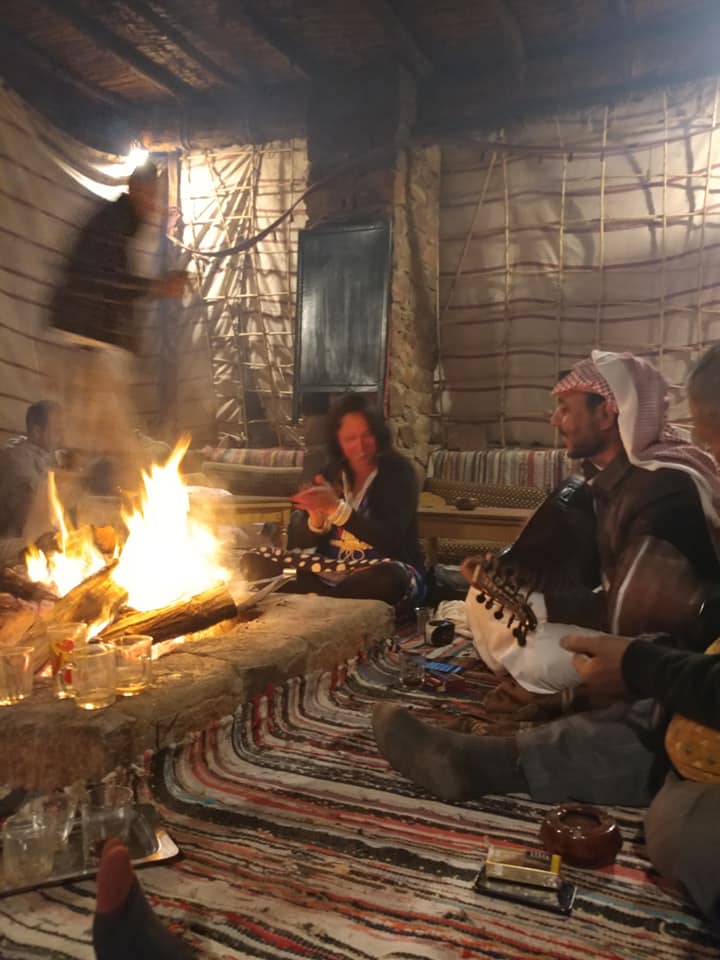
We made our way slowly down the mountain as the evening tranquility descended upon the valley. Saint Catherine’s monastery beckoned, and Sheikh Mousa’s Bedouin camp promised food and a place to sleep. On our way down a fellow traveler made the sign of one hand clapping, a Zen greeting, and our recognizable faces were greeted with joyful exclamations: Hindi, India and namaste. When we arrived at the Bedouin tent there was a campfire and company. I made friends with three magic women. There was no disparity, religious or otherwise, only elemental nature, animals, human laughter, and wordless gratitude for being alive.  

The Monastery of St Catherine contained fascinating secrets, both scholarly and mystic. At its heart it is dedicated to two women. Patriarchal systems do not like women who dare to tread beyond prescribed boundaries asking fundamental questions. Two extraordinary women were brutally killed in Alexandria: the philosopher Hypatia in the name of Christianity and St Catherine in the name of paganism. Both women are virtually indistinguishable except for their supposedly opposing beliefs. It is possible that they are the same person. 

Most religions and their academic study are dominated by men, but the Hermetic and transformative aspects of every tradition are only accessible via the feminine. The feminine cannot be contained by any commandment; however, she can be intuited by profound humility and indomitable courage. It was fitting that we accompanied three rebel women to pay our respect to St Catherine where we beheld the light falling on the burning bush that believers venerate.

At the camp, we first heard about a virus originating in China. We packed our bags one more time stopping in Dahab on the Red Sea and then returning to Cairo and home. Flying over the Red Sea and the Nile left a strange pang in my heart. It was great, good fortune to see a portion of this land and meet its gentle and kind men and women. However, its recent history has been raw and tumultuous. I had enthusiastically assigned the Arab Spring in my class while it was happening in 2010. Now things are eerily quiet. Travelers come and go, but the people must find better ways of being without suffocating power structures. While the world suffers from Mother Earth’s time out, perhaps human beings will find their lost Osirian heads and reconnect with the sheltering wisdom under the outstretched wings of Isis.


Friday, August 9, 2019

Circles, Chalices, Spirals, and Tors of Great Britain: Stones and Waters Sing of the Mother - Neela Bhattacharya Saxena


I am frequently visited by Mnemosyne, the Greek goddess of memory. She sparks a remembrance so deep in the collective psyche that only what Socrates calls anamnesis or the practice of pratyabhijna (re-collecting gnosis, Sanskrit) can resurrect it. In Hades, the dead drank from the river Lethe to forget this life. If you followed the Orphic/Pythagorean mysteries, you would drink from Mnemosyne, also the mother of the Nine Muses, to remember the pieces of the Self. Thus, begins a remembrance of things recently passed, of a journey to the British Isles where the mists of Avalon lift momentarily to let us peek into HER mystery.
Mnemosyne was one of those goddesses who had to be “forgotten” to establish the Olympian patriarchy. This worldwide forgetting of the source of our being has serious and terrifying consequences. But one can’t quite forget a Titan because she sings within us, sometimes as vague unease; sometimes she charts a delightful path leading to pre-historic stones whose memory cannot be eradicated. While the beleaguered Great Britain was changing guards to assert its lost supremacy and Brexiting, she was helping erstwhile colonial subjects discover its treasures for their own creative usage.

The British Museum is brimming with imperial loot. Sacred objects like this undulating, double headed turquoise Aztec serpent represent an inner truth -"the way upward and the way downward is one and the same." This fragment from Heraclitus is one of the epigraphs that begins T. S. Eliot’s “Burnt Norton.” The first poem of the Four Quartets that Eliot, an American who embraced Britannia, chanted to redeem himself. His deep memory revealed the mystery of the eternal spiraling of time within the circular womb: “Time present and time past/Are both perhaps present in time future, /And time future contained in time past.”
Our journey was serpentine, serendipitous and spiraled through the magic isles. Tower of St. Mary Magdalene welcomed us to Canterbury and brought me to the pilgrimage point I read in Chaucer during my college English days. The Church was demolished in 1871 and a baroque monument from 1680 was established there.  Miriam of Magdala has remained until very recently the most misrepresented Lady of Christianity since the saga of Jesus was truncated by patriarchal Christendom. Yet the land retains her memory in more ways than one can imagine. I was pleased that it was her tower/tor that launched our pilgrimage, a journey mainly conceived by my husband, an avid lover of history and Arthurian tales.
Canterbury Cathedral was the first sacred site on the way to a philosophy conference in Bath - my excuse for the voyage. I recalled Chaucer’s “Wyf of Bathe,” a scandalously sharp woman with at least five husbands who tells the tale of “what women truly want” on her way to Canterbury. Through the tale of a rapist, an Arthurian Knight no less, whom Queen Guinevere saves from execution and sends on a different kind of quest, Chaucer shows how women desire sovereignty over their bodies.  It was set in the backdrop of a recently buried Avalonia under patriarchal Christianity that reveals medieval England’s unease with independent women.
Hence it was fitting that we stopped at Glastonbury on our way to Bath and paid tribute to the mystery of Magdalene’s Chalice and the Tor, the legendary entrance to Avalon. History, mythology, religion and our interior landscape, marked by sacred symbols of the people who inhabited this land, effortlessly intermingle here. The Chalice Garden below the Tor and Glastonbury Abbey are magical places where the ancient tale of the Holy Grail blended with the new religion. Joseph of Arimathea is supposed to have traveled here from Jerusalem with the famed vessel.
Glastonbury Abbey also allegedly contains the tomb of Arthur and his unforgettable Queen. It houses the most ancient ruins of a Lady Chapel. A dove at a ledge near the Virgin’s altar sat still as if rapt in meditation like Wordsworth’s nun. William, a singer of Lyrical Ballads and lover of Nature’s mysteries once sang: “With an eye made quiet by the power of harmony, and the deep power of joy, we see into the life of things.” He, like his fellow poets of the land, must have been intoxicated with the waters of Mnemosyne. 
This Abbey reveals how many women like Jean Shinoda Bolen, and some men, unknowingly “Cross into Avalon”, the gateway to the land of the dead that the Tor signifies, and remember their birthright. That birthright awakens them to their full humanity and creates a seamless entry into the Kingdom with no rancor between Nature, divinity and humanity. While truth remains elusive, our mythic imagination creates enchanting tales that speak to the wellspring of our being - the Mother Principle that gives birth to and balances the masculine and the feminine within us.
Given the imbalance in the world and the loss of the feminine, it was fun to discover the balancing Star of David, two intersecting triangles, an entangled Yin/Yang symbol from the Jewish world, hiding in plain sight in Winchester Cathedral.  The Rosslyn Chapel that we visited later hid many pagan symbols in its Lady Chapel including the Green Man but discovering the star as an anomalous design at this most ornate cathedral, the seat of medieval Britain’s royal power was delightful and auspicious. See if you can locate it!
We entered the World Heritage Site, the city of Bath on the wings of philo-Sophia and were enchanted by the Celtic and Roman goddesses that often disguised themselves in various forms. Seneca wrote in the first century: “We…. erect altars at places where great streams burst suddenly from hidden sources; we honor hot springs of water as divine.” We need such wisdom today so we can see how we pollute our own being as we desecrate the waters of life. The temple pediment in Bath sites these lines from Solinus in 3rd century CE: “….in her temple the eternal flames never whiten into ash, but rather, when the fire dies away, it turns into rocky round masses.” Was the writer referring to the rocky round barrows we saw all over the place?      
                            
Taking a sip from the holy waters of the spring must have awakened Mnemosyne in me and reminded me of Goddess Kamakhya in the hills of Assam. Kamakhya inspired me to write my first book: In the Beginning IS Desire. The waters of the sacred hot spring at Bath were meant for pilgrims to cleanse and heal themselves before paying homage to the Celtic and Roman goddess Sulis Minerva. A painter sought to give vision to Cignus the Swan which is the sacred constellation of the Celtic goddess Brigid, and a Catholic saint. After all goddesses do not care about religious identity; they simply point the way to the still center of our spiraling mind.
Geometric circles, spirals, tors and triangles- markers of goddess religions, are much older than Greeks, Romans or Avalonians.  If one end of our sojourn had the fragrance of the two Marys, the Virgin and the Magdalene, and the complex aroma of Morgan Le Fay, the other end was imbued with the grandeur of grassy barrows, stone circles and the most magnificent natural monuments from Dover’s white cliffs to the Isle of Skye’s Old Man of Storr. Deep memory triggered by Mnemosyne’s blessings and the texture of the land led my imaginal mind to a past when humans knew that the Sun and the Moon are not just external entities but intricately connected with human evolution. 

We showed up at a newly curated Stonehenge surrounded by an empty landscape and ancient mounds. We passed through Old Sarum and Salisbury. All over the place Ravens were singing of the void at the center of this famous sanctuary. They were pointing to Amesbury and innumerable others all the way to the Scottish Highlands. We ended up seeing the 12 apostles in Dumfries, Callanish stones in the Outer Hebrides in the Isle of Lewis and many others before reaching the summit of our stony trip in Orkney. One takes hazardous single lane roads through the breathtaking Scottish Highlands and Lochs to encircle the sacred stones that dot the land.
The Mists of Avalon take a completely different tenor as one enters the dangerous waters that separate the Orkneys. From the ship one can see the Old Man of Hoy rising out of a misty rocky landscape. Then we were in the heart of Neolithic Orkney with Skara Brae, Europe’s best-preserved Neolithic village, the Standing Stones of Stenness, the massive Ring of Brodgar and the over 5000-year-old chambered cairn of Maeshowe. The cairn was visited a thousand years ago by Vikings who left their runic graffiti for us to inspect. Maeshowe is aligned with the standing stones and the winter solstice. It could very well be the cave of Merlin, the master magician of Avalon and restorer of the Giant’s Dance.
A circular journey around the British Isles also bared the depths of its ecclesiastical history. Its chronicler Venerable Bede’s 7th century Saxon monastery is still standing; so is the Holy Island of Lindisfarne. However, the dissolution of monasteries carried out by King Henry VIII had a peculiar effect on the land. We found the ruined abbeys, including Fountains and Whitby, more beautiful in their stark emptiness than the sumptuous cathedrals that were saved by various alliances. However, the ruins of Lanercost priory next to a parish church of Mary Magdalene reminded that Magdalene is awake in the land.
Journeys require guides and sometimes they show up in strange guise, a boatman or a charioteer.  One of the hidden gems we were led to was a hermitage behind Warkworth Castle. To reach it you had to cross the river Coquet with the help of a ferryman.  The chapel was carved out of the cliff rock and some stones were shaped to make a recumbent Virgin with child.  A serene and resolute Joseph was standing guard at the foot of the rocky bed.  Like the ruined abbeys this hermitage spoke the language of silence, and here lies a sort of the Virgin of the Rocks.
Goddess rituals, ancient and contemporary, include circle dances, labyrinthine trances and incubation inside darkened cave shrines.  As we descended from the top of our journey in Orkney, I suddenly found myself joining a circle dance they call Taizo in Findhorn and recognized how traditions remain alive in many forms. It must be the Great Goddess spinning her magic sitting at her loom. When I asked my unknown partner her name, she said Kali; did I hear it wrong? I asked again; she uttered the same sound. My Kali saturated ear probably misheard the European name - Kallie or Callie! 
British philosopher Peter Kingsley has been writing about incubation rituals in goddess temples that Greek philosophers from Empedocles to Parmenides participated; Plato too was linked to Eleusinian mysteries. Sleeping in a dark cave could lead to cleansing dreams of dying to one’s ordinary life. Entering and exiting a sacred circle or a spiraling labyrinth is a way to enter the depth of one’s being and encounter death and resurrection.  Resting inside a grave like structure next to the magnificent ruins of Whitby Abbey reminded me of the cremation ground meditation that the Buddha taught.
I somehow come full circle to the Buddha who lived at a time when the Greeks still worshipped their goddesses. It was a magnificent day and the landscape was changing from pasture lands to deep forests. We passed through a pre-historic site and reached the Kagyu Samye Ling monastery built by Chogyam Trungpa Rimpoche in the heart of Scotland. A magnificent Tara and the murti of the second Buddha Padmasambhava filled the landscape with color.  The river Esk was flowing behind the monastery and a soft grassy spiral adorned a corner of its garden. 
Tibetan prayer flags and wheels felt out of place; so did the statue of Mahayana philosopher and for some, a tantric master, Nagarjuna wrapped in a spiraling stony serpent whose cobra head was protecting his meditating body. I momentarily sat in the shrine and encircled the monastery wondering about stranger gods comfortably inhabiting this ancient land of stone circles and mystic magicians. As I conclude this reverie about our sojourn on this magnificent island, contemplate the vagaries of history and my strange affinity with these isles, I watch my Muse, Mnemosyne, dissolve into the reflecting pool that mirrors the mind of a master along with a blue sky and its fleeting clouds.